
Brake pads are small parts with a direct impact on safety: they create the friction that slows the wheels and brings the vehicle to a stop. If you are comparing a set of front brake pads or checking whether yours are worn, the key is to understand how they work, when to inspect them, and why replacing them too late can damage the brake discs.
What brake pads do inside the braking system
Brake pads are friction components used in disc brakes and, in a related form, in drum brakes. Their job is simple: they press against a rotating surface and slow it down. On most modern cars with disc brakes, that surface is the brake disc, which turns with the wheel.
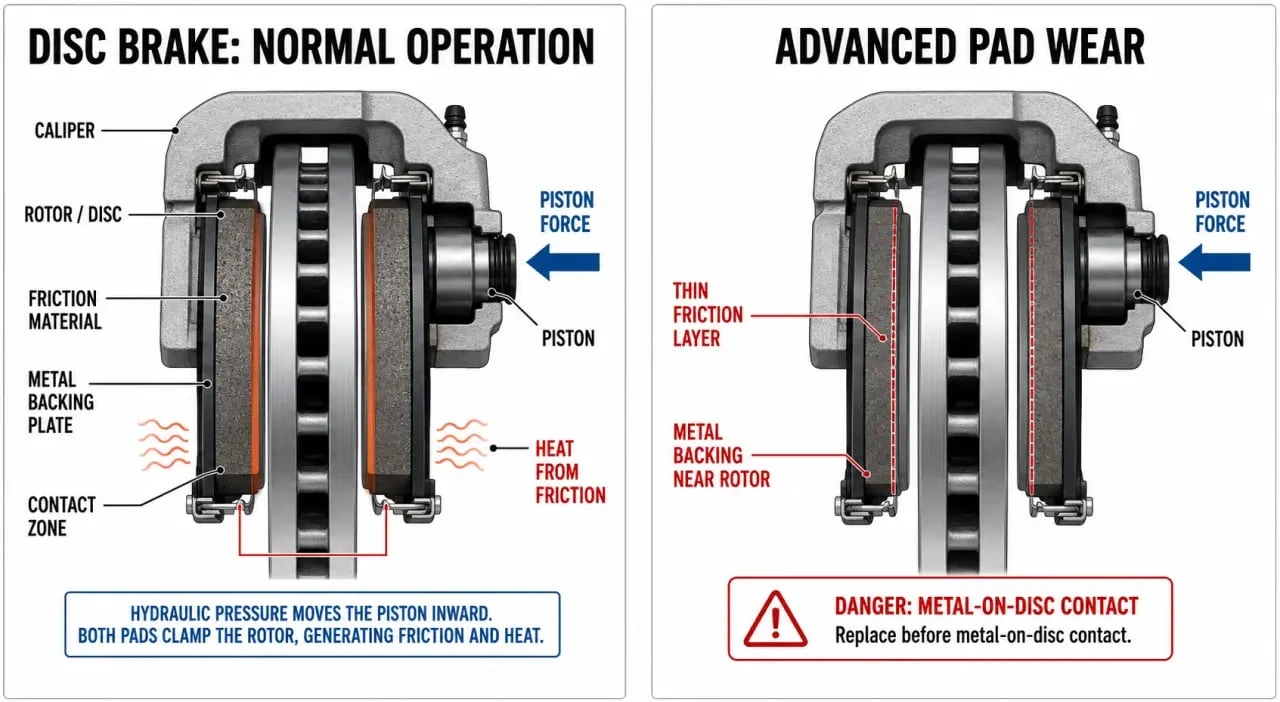
A brake pad has two main parts: a friction lining and a metal support. The lining is the part designed to rub against the disc. It is made to grip, resist heat and wear gradually. The metal support gives the pad its shape and helps it sit correctly in the brake caliper.
When the brake pedal is pressed, the caliper pushes the pads against both sides of the disc. The pads pinch the disc, friction rises, wheel rotation slows, and the vehicle loses speed. Friction turns kinetic energy into heat, so brakes must grip and also manage temperature. That is why ventilation and heat resistance matter as much as bite.
Disc brakes, drum brakes and the same basic principle
In a disc brake, the pads clamp onto a visible disc. In a drum brake, the friction material presses against the inside of a rotating drum. The layout changes, but the logic stays the same: a softer lining meets a harder rotating surface to slow the vehicle without wearing the disc or drum too quickly.
Some discs are grooved or perforated to improve ventilation. That matters because heat is part of braking, not a problem that can be ignored. Better ventilation helps the system cope with repeated braking, especially when speed, load or driving conditions put more demand on the brakes.
When to inspect or replace brake pads
Manufacturers commonly recommend inspecting brake pads every 2 years or between 20,000 km and 30,000 km, depending on the driving environment. This is an inspection interval, not a promise that every pad will last exactly that long. Wear depends heavily on how and where the vehicle is driven.
Understanding Brake Pad Wear Sensors: A Complete Guide — Learn how brake pad wear sensors function and why they are essential for maintaining your vehicle’s safety and braking performance.
City driving accelerates wear because it involves frequent braking, low-speed stops, traffic lights, roundabouts and short acceleration-braking cycles. A car used mostly on open roads may use its pads less aggressively than the same model driven every day in dense urban traffic.
The warning signs that deserve attention
A brake pad warning light can indicate significant wear. On some vehicles, a brake fluid level warning may also point to pad wear, because the braking system compensates as the pads become thinner. These alerts are not decorative dashboard messages: they mean the braking system needs checking.
Visual inspection matters too. If the lining has become very thin, the pads are approaching the point where they can no longer do their job properly. At that stage, waiting for noise or a harsher symptom is risky, because the next stage of wear can affect the disc itself.
The useful threshold: replace before the metal appears
Brake pad wear is a threshold issue. For many kilometres, the lining becomes thinner while braking still feels normal. Once the friction layer is nearly gone, the situation changes: the metal support can start to approach the disc. That boundary is the one to avoid. A driver who waits for scraping, noise or a stronger warning may already have moved from routine maintenance to component damage. Thinking in terms of a wear threshold helps you replace the pads before the braking system enters the risk zone.
Why worn brake pads can damage brake discs
Replacing brake pads on time is not only about maintaining braking performance. It also protects the brake discs. When the lining disappears, the metal support of the pad can touch the brake disc. Metal-on-disc contact can scratch the disc surface and reduce braking quality.
This is the real cost of delayed maintenance: a late pad replacement can lead to replacing both pads and discs. Brake pads are meant to wear. Brake discs are wear parts too, but they should not be attacked by the pad backing plate. Once the disc surface is damaged, braking feel and efficiency may change, and disc replacement can become necessary.
Reduced braking efficiency is the real risk
Excessively worn pads can reduce braking efficiency considerably. The vehicle may still slow down, but the system no longer works with the margin it was designed to provide. In everyday driving that margin is easy to overlook. In a sudden stop, on a wet road, or with passengers and luggage, it matters more.
This is why brake pads are safety-critical parts rather than simple comfort items. They sit where mechanical force, friction, heat and vehicle control meet. If one element is too worn, the whole braking chain becomes less reliable.
Front brake pads, rear brake pads and quantity per vehicle
Most cars use 2 brake pads per brake disc, one on each side of the disc. A common vehicle layout therefore uses 8 brake pads in total: 4 front and 4 rear. That is why front brake pads are often sold as a set of 4, covering both front wheels.
Front brake pads are a major product category because the front axle carries a large part of the braking load. When the vehicle slows, weight transfers forward, which increases the workload on the front braking system. Rear pads still matter, but front pads often receive the most attention during maintenance and product searches.
Compatibility is not optional
Brake pad shape and size vary according to the vehicle brand and model. A set that looks similar may not fit correctly in the caliper, may not match the disc, or may not correspond to the intended axle. Before buying, check the exact vehicle application and whether the set is for the front or rear axle.
The phrase “set of 4 front brake pads” usually means enough pads for the two front discs: two pads on the left front disc and two on the right front disc. It does not normally cover the rear axle. If all pads need replacing, the vehicle may require both a front set and a rear set, depending on its braking configuration.
| Item to check | What it means | Why it matters |
|---|---|---|
| Front or rear axle | The set must match the position on the vehicle | Front and rear pads may differ in shape and size |
| Number of pads | Most cars use 2 pads per disc | A common full vehicle total is 8 pads |
| Vehicle compatibility | Pad dimensions depend on the model | Correct fit is essential for caliper and disc contact |
| Wear indicators | Warning light or brake fluid level alert | They can signal significant pad wear |
Materials, heat and different use cases
Brake pad materials vary according to durability, braking power, aggressiveness toward the disc and intended use. A city car, a racing vehicle, an aircraft and a bicycle do not ask the same things from their braking systems, even if all rely on friction to slow a rotating part.
The lining must work well without destroying the surface it touches too quickly. In drum brakes, for example, the lining is softer than the steel or cast iron drum so the drum does not wear prematurely. In disc brakes, the same balance applies between grip, heat resistance and disc preservation.
High-performance braking shows why heat matters
Aircraft brakes may use alternating fixed and rotating discs, in an arrangement comparable to a clutch. Ceramic is increasingly used in demanding applications such as aircraft, Formula 1 and some high-end sports cars. These examples show the same principle pushed to extremes: powerful braking creates heat, and the material must stay stable while managing it.
For everyday vehicles, the takeaway is practical. Choose brake pads that match the vehicle and use case, inspect them at sensible intervals, and replace them before the lining disappears. Good brake pads are not just parts that fit; they are parts that preserve braking quality, protect the discs and keep the system within its intended safety margin.

- Brake Pads: Inspect Them Every 2 Years, Replace Before the Lining Disappears, and Protect the Discs - 12 juillet 2026
- Validité du code de la route : 5 ans de délai, 5 essais et les cas où il faut le repasser - 12 juillet 2026
- Marques de camions : comparer les constructeurs selon l’usage, du transport longue distance au chantier - 12 juillet 2026
Articles qui pourraient vous intéresser :
 Autoglassfrance.fr accessoires : bien choisir et profiter des meilleurs équipements
 Lire un ticket de chronotachygraphe : guide clair pour ne plus se tromper
 Moteur puma ford transit : fiabilité, problèmes connus et conseils d’achat
 Location de voiture entre particuliers sans caution : 5 jours pour libérer votre budget